







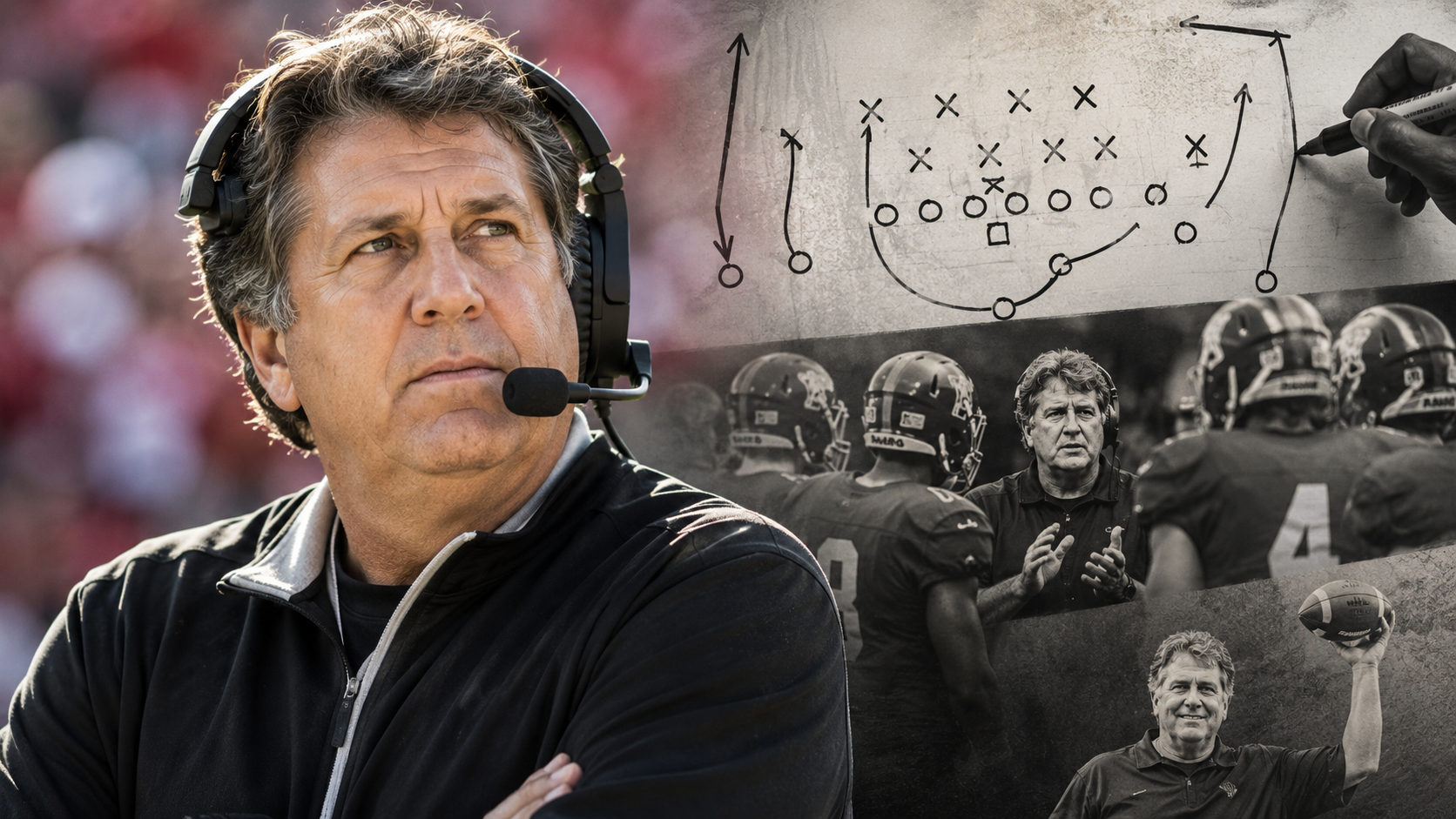
Few coaches in college football history left as distinctive a mark as Mike Leach. He was unconventional, quotable, and genuinely original — a lawyer-turned-coach who turned small programs into passing powerhouses and changed how the game was played at every level. People search for Mike Leach for all kinds of reasons: his coaching record, the Air Raid offense he helped popularize, his time at Texas Tech and Mississippi State, or the circumstances of his death in December 2022. This article covers all of it.
Who Was Mike Leach?
Mike Leach was an American college football head coach best known for developing and spreading the Air Raid offense — a pass-heavy system that prioritized spacing, tempo, and volume of throws over traditional run-first football. He served as head coach at Texas Tech University from 2000 to 2009, and later at Washington State University from 2012 to 2019, and Mississippi State University from 2020 until his death in December 2022.
Born on March 9, 1961, in Susanville, California, Leach earned a law degree from Pepperdine University before pursuing a career in coaching. He never played college football at a high level, which made his eventual influence on the sport all the more remarkable.
The Air Raid Offense: What It Is and Why It Matters
Origins of the System
The Air Raid offense wasn’t invented by Leach alone. He developed it alongside Hal Mumme, his mentor and the head coach at Valdosta State and later Kentucky, where Leach served as offensive coordinator in the late 1990s. The system drew from concepts developed by coaches like Mouse Davis and June Jones in the run-and-shoot era, but Mumme and Leach refined it into something more structured and replicable.
The core idea is simple: spread the field with four or five receivers, force defenses to cover every inch of it, and throw the ball — constantly. Traditional football wisdom said you needed a strong running game to set up the pass. The Air Raid argued the opposite.
How It Works
The Air Raid uses a few foundational concepts that appear in endless variations:
Four verticals — All four receivers run straight down the field, stretching the defense vertically and opening throwing lanes.
Mesh — Two receivers cross paths near the line of scrimmage in opposite directions, creating natural picks and forcing defenders to make quick decisions.
Y-cross — A deeper crossing route designed to attack the middle of the field.
What makes the system effective isn’t any single play — it’s the volume and repetition. Teams run the same route combinations hundreds of times in practice until the execution becomes automatic, and defenses see so many variations that they struggle to prepare for all of them.
Impact on College and Pro Football
Leach’s success at Texas Tech helped legitimize the Air Raid at the major college level. His former players and assistants — including Dana Holgorsen, Kliff Kingsbury, Lincoln Riley, and others — spread the system across the country. Today, passing concepts rooted in Air Raid principles appear in NFL playbooks, high school programs, and everywhere in between.
Mike Leach’s Coaching Career
Early Career and Rise
After his time with Hal Mumme at Iowa Wesleyan and Valdosta State, Leach joined Mumme at Kentucky as offensive coordinator in 1997. The Wildcats’ passing attack drew national attention and caught the eye of Texas Tech, which hired Leach as head coach in 2000.
Texas Tech (2000–2009)
Leach built Texas Tech into a legitimate Big 12 contender. His teams consistently ranked among the nation’s leaders in passing yards, and he produced several NFL quarterbacks, most notably Patrick Mahomes’ predecessor in the system, Graham Harrell, and earlier stars like Kliff Kingsbury.
His 2008 season was arguably his best — Texas Tech went 11–1 in the regular season, rose to No. 2 in the national rankings, and beat a previously undefeated Texas team in one of the most memorable upsets of that decade.
His tenure ended abruptly following a highly publicized dispute involving a player and allegations about how Leach handled the situation. Texas Tech fired him in December 2009, and a legal dispute followed. The circumstances remain contested by different parties.
Washington State (2012–2019)
After sitting out the 2010 and 2011 seasons, Leach took over at Washington State, a program that had struggled for years. He steadily rebuilt it, and by 2017 and 2018 the Cougars were competing for Pac-12 titles and finishing in the top 25 nationally. His work at Washington State is widely considered a model of what a coaching staff can do with limited recruiting resources by committing fully to a system.
Mississippi State (2020–2022)
Leach’s final stop was Mississippi State, where he arrived in 2020. The Bulldogs reached bowl games and showed flashes of the high-flying offense fans expected. He was also characteristically outspoken — discussing everything from pirate history to the nature of laziness in his press conferences, which became must-watch events for college football fans regardless of which team they followed.
Mike Leach Beyond Football
Leach was as well known for his personality as his coaching. He gave rambling, philosophical press conference answers. He wrote a book about pirate history. He maintained genuine, wide-ranging intellectual interests that had nothing to do with football — and he talked about all of them openly and without apology.
He was also known for his loyalty to his former players and assistants. The coaching tree he built is one of the most influential in modern college football, and many of those coaches have spoken about how thoroughly he invested in their development.
Death and Legacy
Mike Leach died on December 12, 2022, at the age of 61, following a cardiac event he suffered at his home in Starkville, Mississippi, two days earlier. The response from the football community was immediate and widespread. Former players, rival coaches, and fans across the country shared tributes that spoke to both his football influence and his character as a person.
His legacy rests on a few pillars: the Air Raid offense and its spread throughout football, the programs he rebuilt with limited resources, the coaches he developed, and an approach to the game that was entirely his own.
Common Misconceptions About Mike Leach
“The Air Raid is just a gimmick.” This was a common criticism early in Leach’s career. The results over two-plus decades at multiple programs answered it. The system works at every level of football because it’s based on sound spacing principles, not tricks.
“Leach couldn’t recruit.” He wasn’t at programs like Alabama or Ohio State with unlimited recruiting advantages. But he developed players effectively enough that many went on to NFL careers, and his system maximized talent that other programs overlooked.
“His offenses couldn’t win big games.” The 2008 Texas Tech season, multiple Pac-12 contention years at Washington State, and consistent bowl appearances across three programs suggest otherwise. Leach never won a national championship, but the programs he coached were significantly better with him than without him.
Key Facts
- Born: March 9, 1961, in Susanville, California
- Died: December 12, 2022, in Lubbock, Texas (after collapsing in Starkville, Mississippi)
- Overall coaching record: 158–107 as a head coach
- Developed the Air Raid offense alongside mentor Hal Mumme
- Head coach at Texas Tech (2000–2009), Washington State (2012–2019), Mississippi State (2020–2022)
- Holds a law degree from Pepperdine University
- His coaching tree includes Lincoln Riley, Kliff Kingsbury, Dana Holgorsen, and others
- His 2008 Texas Tech team reached No. 2 in the national rankings
Frequently Asked Questions
What is Mike Leach most famous for?
He’s best known for the Air Raid offense, a pass-heavy system he helped develop and spread throughout college and professional football over three decades of coaching.
Where did Mike Leach coach?
His three head coaching positions were at Texas Tech (2000–2009), Washington State (2012–2019), and Mississippi State (2020–2022).
How did Mike Leach die?
Leach suffered a cardiac event at his home in Starkville, Mississippi on December 10, 2022, and died two days later on December 12, 2022, at the age of 61.
Did Mike Leach ever win a national championship?
No. Despite building multiple programs into contenders, Leach never won a national title. His closest moment was the undefeated regular season run at Texas Tech in 2008, which ended with a loss in the Big 12 Championship game.
What is the Air Raid offense?
It’s a spread passing system built around spacing, route combinations, and high-volume throws. It deprioritizes the running game in favor of forcing defenses to defend the entire field through the air.
Who carried on Mike Leach’s coaching legacy?
Several of his former assistants and players became head coaches, including Lincoln Riley (USC), Kliff Kingsbury (NFL/Tennessee Titans), and Dana Holgorsen (Houston), all of whom run systems influenced by Leach’s approach.
Key Takeaways
- Mike Leach was one of college football’s most influential coaches, known for the Air Raid offense and unconventional personality.
- He spent his head coaching career at Texas Tech, Washington State, and Mississippi State.
- The Air Raid offense he helped develop has influenced football at every level.
- His coaching tree — including Lincoln Riley and Kliff Kingsbury — continues to shape the game.
- He died on December 12, 2022, at age 61, following a cardiac event.
- His legacy is defined not just by wins and losses, but by how fundamentally he changed how football is played and taught.
Wrapping Up
Mike Leach spent his career proving that football didn’t have to be played the way it always had been. He took over programs that others had written off, installed a system that defied conventional wisdom, and produced results that eventually made that wisdom look outdated. Beyond the coaching record, he was a genuinely original thinker whose press conferences, interviews, and public persona made him one of the most recognizable figures in the sport. His death in 2022 marked the end of a singular career — and the beginning of what will likely be a very long conversation about what he contributed to the game.