









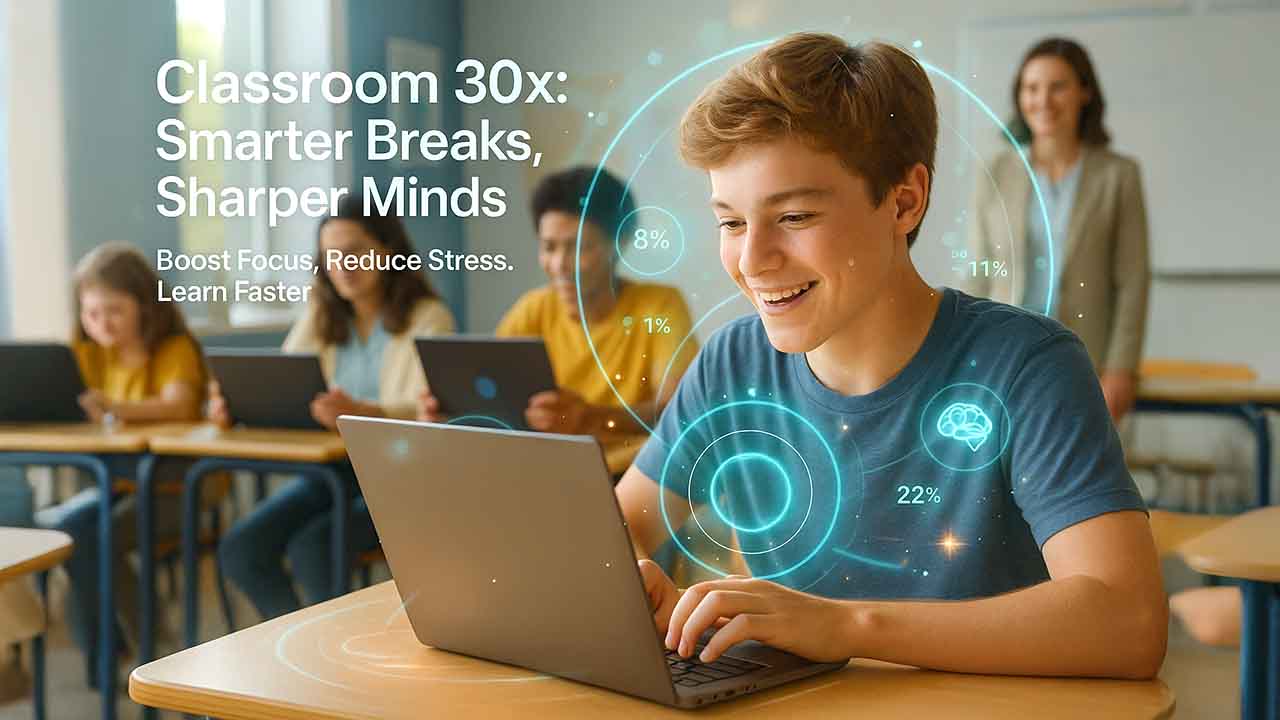
In today’s fast-moving digital economy, the gap between what people learn and what industries actually need is widening at an uncomfortable pace. Companies are scaling faster than ever, technologies are evolving in months instead of years, and traditional education systems are struggling to keep up. This is where classroom 30x enters the conversation—not as a buzzword, but as a signal of how learning systems are being re-engineered for speed, intelligence, and global scale.
For startup founders and tech professionals, this shift is not abstract. It directly impacts how talent is built, how teams are trained, and how knowledge is distributed across organizations. Education is no longer confined to schools or universities. It is becoming a continuous layer embedded into products, workplaces, and digital ecosystems. Classroom 30x represents this transition toward learning environments that behave more like intelligent software systems than static institutions.
What makes this moment particularly significant is that we are witnessing the convergence of AI, cloud infrastructure, and behavioral analytics into a single learning paradigm. The result is a system where education adapts in real time to the learner, rather than forcing the learner to adapt to the system.
Understanding Classroom 30x as a System, Not a Platform
To fully understand classroom 30x, it helps to step away from traditional definitions of education technology. This is not simply an upgraded LMS or a digital classroom tool. It is better understood as an adaptive learning system that continuously evolves based on user interaction.
In conventional classrooms, learning follows a fixed structure. Content is delivered, students absorb it at varying speeds, and assessments are conducted periodically. The system assumes uniformity. Classroom 30x removes that assumption entirely.
Instead, it introduces a dynamic feedback loop where every interaction—every quiz attempt, video pause, discussion participation, or assignment submission—feeds into a real-time model of the learner. The system then adjusts difficulty, pacing, and content delivery accordingly.
This creates a learning experience that is not only personalized but also continuously optimized. No two learners follow the exact same path, and even the same learner experiences different learning trajectories over time depending on performance and engagement.
Why Classroom 30x Matters in the Modern Economy
The relevance of classroom 30x becomes clearer when viewed through the lens of workforce transformation. Industries today are driven by rapid technological change, and skills that are relevant today may become obsolete within a few years—or even months.
Traditional education systems were designed for stability. They assume that knowledge remains relatively consistent over time. But in a world driven by AI, automation, and digital transformation, stability is no longer the norm.
Classroom 30x introduces agility into learning systems. It enables organizations to update training content instantly, adjust learning paths based on new industry requirements, and scale skill development across distributed teams without rebuilding entire curricula.
For startups, this is particularly powerful. Talent development is one of the most expensive and time-consuming challenges in scaling a company. A system that can accelerate onboarding, personalize training, and continuously upskill employees becomes a strategic advantage rather than a support function.
The Architecture Behind Classroom 30x Systems
At a technical level, classroom 30x is built on a layered architecture designed for intelligence and scalability. Each layer serves a specific function, but the real power comes from how they interact.
| System Layer | Core Function | Business Impact |
| Intelligence Layer | AI-driven personalization and prediction | Tailors learning paths dynamically |
| Data Layer | Captures behavioral and performance signals | Enables real-time optimization |
| Content Layer | Manages structured and multimedia learning assets | Ensures scalable content delivery |
| Interaction Layer | Supports collaboration and communication | Enhances engagement and peer learning |
| Evaluation Layer | Continuously assesses knowledge and progress | Replaces static exams with adaptive testing |
The intelligence layer is the most transformative component. It uses machine learning models to analyze patterns in how users learn, identify gaps in understanding, and predict future performance outcomes.
The data layer acts as the nervous system of the platform, collecting granular behavioral signals. This includes time spent on tasks, interaction frequency, error patterns, and engagement depth.
Together, these layers create a system that evolves continuously. Instead of being updated manually, the learning environment improves itself through usage.
The Startup Opportunity Hidden in Classroom 30x
From a business perspective, classroom 30x represents a shift from content-based education products to intelligence-driven learning infrastructure.
Traditional edtech companies often compete on course libraries, instructors, or certifications. But in a classroom 30x-driven ecosystem, the competitive advantage shifts toward adaptability, data intelligence, and system design.
Startups entering this space are building AI tutors, adaptive assessment engines, enterprise training platforms, and skill verification systems that integrate directly into workflows.
The economics are particularly attractive. Education products built on adaptive systems naturally encourage long-term engagement. Learners do not complete a single course and leave; they continue interacting with the system as their skills evolve.
This creates strong retention loops and predictable recurring revenue models.
It also opens opportunities for outcome-based pricing, where platforms are paid based on skill improvement or performance gains rather than content access alone. This aligns incentives between providers and users in a more meaningful way.
Real-World Applications Across Industries
While classroom 30x originated as an educational concept, its applications extend far beyond traditional learning environments.
In corporate settings, it is being used for continuous employee training. Instead of static onboarding modules, employees are placed into adaptive learning journeys that adjust based on role, experience level, and performance feedback.
In technical fields like software engineering, platforms use real-time coding assessments and interactive simulations to accelerate skill acquisition. Learners receive immediate feedback, allowing them to correct mistakes and improve faster than traditional methods allow.
Even in healthcare and engineering, where precision and compliance are critical, adaptive learning systems are being used to ensure professionals remain up to date with evolving standards.
The common thread across all these applications is efficiency at scale. Organizations can train large groups of people without sacrificing personalization or quality.
Challenges in Scaling Classroom 30x Systems
Despite its advantages, implementing classroom 30x at scale presents several structural challenges that organizations must navigate carefully.
One of the most persistent issues is infrastructure inequality. Adaptive learning systems require stable internet connectivity, modern devices, and consistent access to digital environments. In regions where these conditions are not met, adoption becomes uneven.
Another challenge lies in system complexity. Building real-time adaptive platforms requires expertise across AI, data engineering, UX design, and educational psychology. Many organizations underestimate the difficulty of maintaining these systems at scale.
Data privacy is also a critical concern. Since classroom 30x systems rely heavily on behavioral data to function effectively, they must be designed with strong security frameworks and transparent data usage policies. Trust becomes a core product feature, not an afterthought.
Finally, there is the challenge of balancing automation with human interaction. While AI can optimize learning paths, it cannot fully replace mentorship, emotional support, or contextual understanding provided by educators.
The Role of Human Intelligence in an AI-Driven Classroom
One of the most important misconceptions about classroom 30x is that it removes the need for educators. In reality, it redefines their role.
Instead of focusing on repetitive instruction or grading tasks, educators become learning designers and mentors. They interpret system-generated insights, provide contextual guidance, and support learners in ways that AI cannot replicate.
This shift elevates the teaching profession. It moves educators away from administrative work and toward higher-value cognitive and emotional engagement.
Learners also benefit from this model. Instead of passive consumption, they engage in active learning experiences that combine human mentorship with machine intelligence.
The most effective classroom 30x systems are those that integrate both dimensions seamlessly.
The Future of Learning in a Classroom 30x World
Looking ahead, classroom 30x is likely to evolve into a foundational layer of digital infrastructure, similar to how cloud computing transformed software development.
Learning will become embedded into everyday tools and workflows. Instead of going to a separate platform to learn, users will learn inside the systems they already use—whether that is development environments, business software, or collaborative tools.
AI tutors will become increasingly context-aware, offering guidance in real time based on what users are working on. Skill validation will shift from formal exams to continuous performance tracking.
In this future, education will no longer be a separate phase of life. It will be an ongoing, integrated process that evolves alongside careers and industries.
Conclusion
Classroom 30x represents a fundamental shift in how learning systems are designed, delivered, and experienced. It moves education away from static structures and toward adaptive intelligence that scales globally while remaining deeply personal.
For startups and technology leaders, this is more than an opportunity—it is a transformation in infrastructure. The companies that understand this shift early will not simply build education products; they will build the systems that define how skills are developed in the modern economy.As industries continue to accelerate, the ability to learn quickly, continuously, and intelligently will become one of the most valuable capabilities in the world. Classroom 30x is one of the clearest expressions of that future taking shape today.